
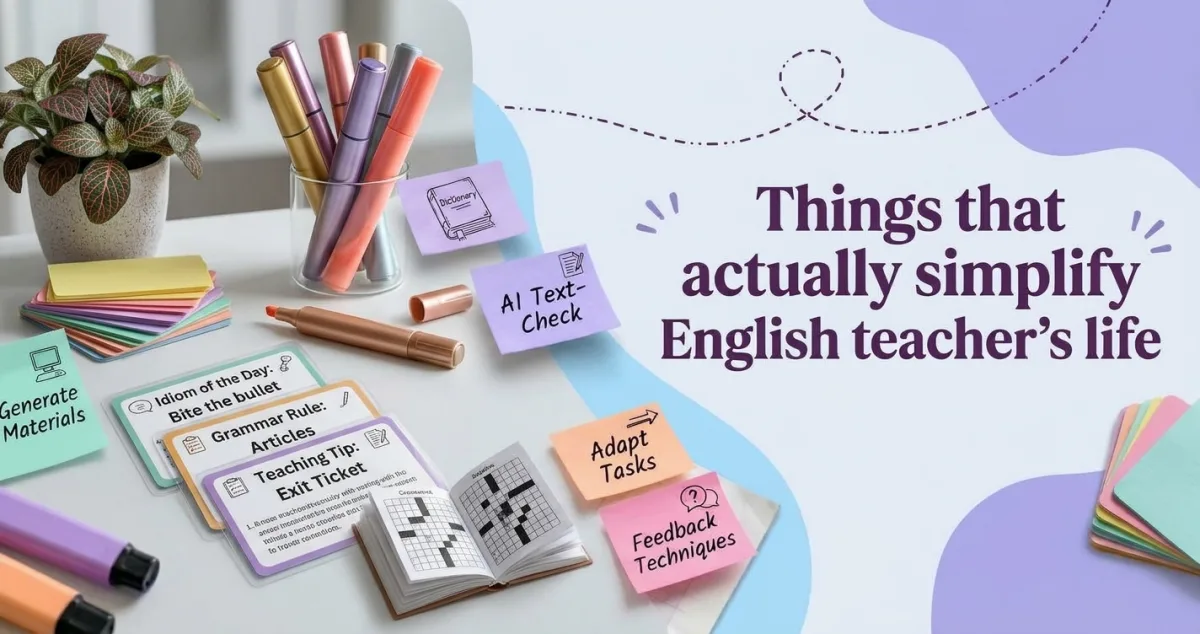
1. Artificial Intelligence as a Personal Assistant
Preparing materials "from scratch" takes up the lion's share of time. Today, artificial intelligence can take over routine tasks:
Content Generation: ChatGPT or Claude can adapt a complex article to a B1 level in seconds, create a list of questions for it, or generate a sample dialogue with target vocabulary.
Vocabulary Analysis: Tools like Oxford Text Checker help quickly check text against the CEFR scale and highlight words that should be explained to students before reading.
Visualization: Platforms like Canva or Midjourney allow you to instantly create flashcards, meme cards for warm-ups, and interactive presentations.
2. Ready-to-Use Lexical Corpora and Dictionaries
To teach students natural language rather than outdated idioms from 90s textbooks, use modern sources:
Oxford 3000 & 5000: Essential vocabulary lists that cover 80–85% of any general English text. This is a benchmark for what is truly worth learning first.
Glosbe / Ludwig.guru: Excellent services for searching for live examples of collocations used in real contexts.
3. Automation of Classroom Interaction
To engage the whole class and avoid spending time on manual test grading:
Bamboozle / Baamz: Special platforms for team review games that do not require student registration.
Wordwall: An ideal option for quickly creating interactive exercises (wheel of fortune, anagrams, matching pairs).
4. Smart Material Differentiation
One of the biggest challenges for a teacher is varying levels of proficiency within the same group. Instead of preparing three completely different lessons, use the principle of "one theme — different support":
Give the whole class the same text to discuss.
Offer open-ended questions to stronger students.
Prepare a short glossary and sentence starters for students who find it harder to overcome the language barrier.
5. Clear Boundaries and Conserving Personal Energy
The most useful thing a teacher can do for their students is to stay rested and energetic:
Templates Instead of Detailed Responses: Create a bank of ready-made comments for grading written assignments.
The 80/20 Rule in Preparation: If a material works well, there is no need to reinvent the wheel every time. Reuse successful lesson frameworks.