
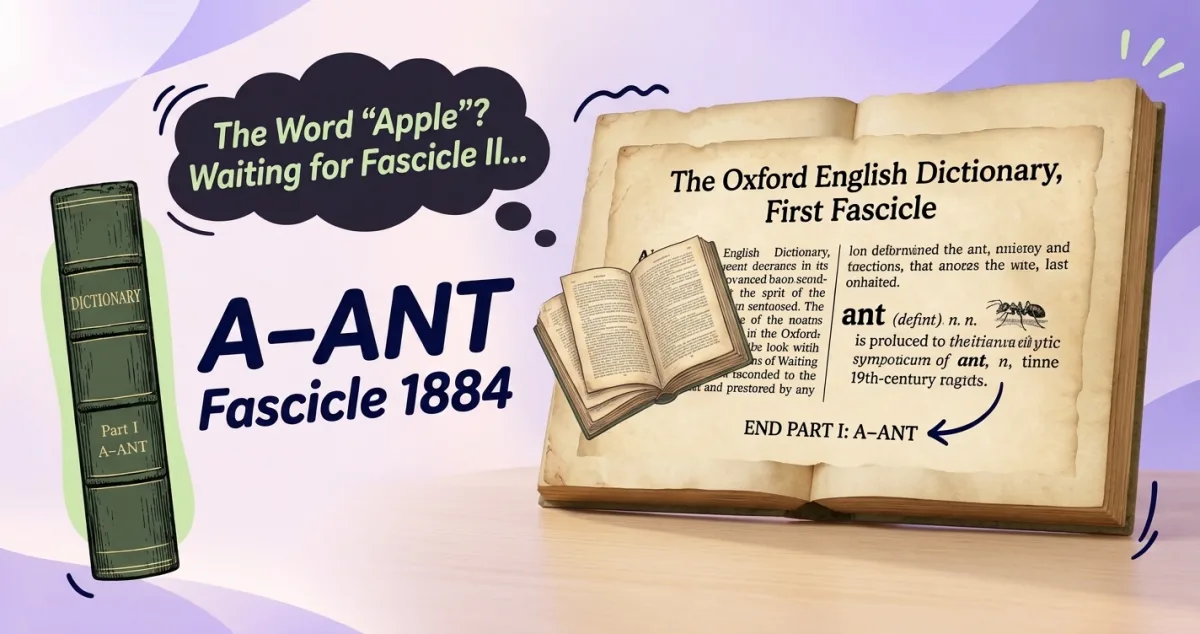
Why "ant"?
The explanation to this riddle could be seen right on the cover of the edition. Directly beneath the name of the editor-in-chief, James Murray, stood a clear label: Part I. A–ANT.
The dictionary was created and published in installments (fascicles) so that readers could use the completed material while the lexicographers continued their monumental work.
The scale of the project turned out to be staggering:
44 years passed between the release of the first part and its full completion.
Over that time, 128 separate issues saw the light of day.
In 1928, all the parts were finally consolidated into 10 monumental volumes.
💡 Lesson Idea: Interactive Warm-up Question
This story can easily be adapted as a quick warm-up activity or practice with alphabetical order during an English lesson.
Task: Write three words on the board: animal, answer, apple.
Ask your students:
“Which of these words would you find in a dictionary that ends at ‘ant’?”
Explanation: To check their answer, students will need to pay close attention to the alphabetical order all the way to the third letter:
The words animal (a-n-i...) and answer (a-n-s...) come in alphabetical order before ant (a-n-t...).
The word apple (a-p-p...) comes after ant, so readers in 1884 had to wait for the next issue to find its definition.
Source: Historical records of the creation of the Oxford English Dictionary (Oxford University Press, 1884–1928).