Knowing the answer does not always mean understanding the question.
It is largely on this idea that the distinctive approach to teaching and learning at the University of Oxford is based. Here, education is not limited to lectures, note-taking, or the memorisation of large amounts of information.
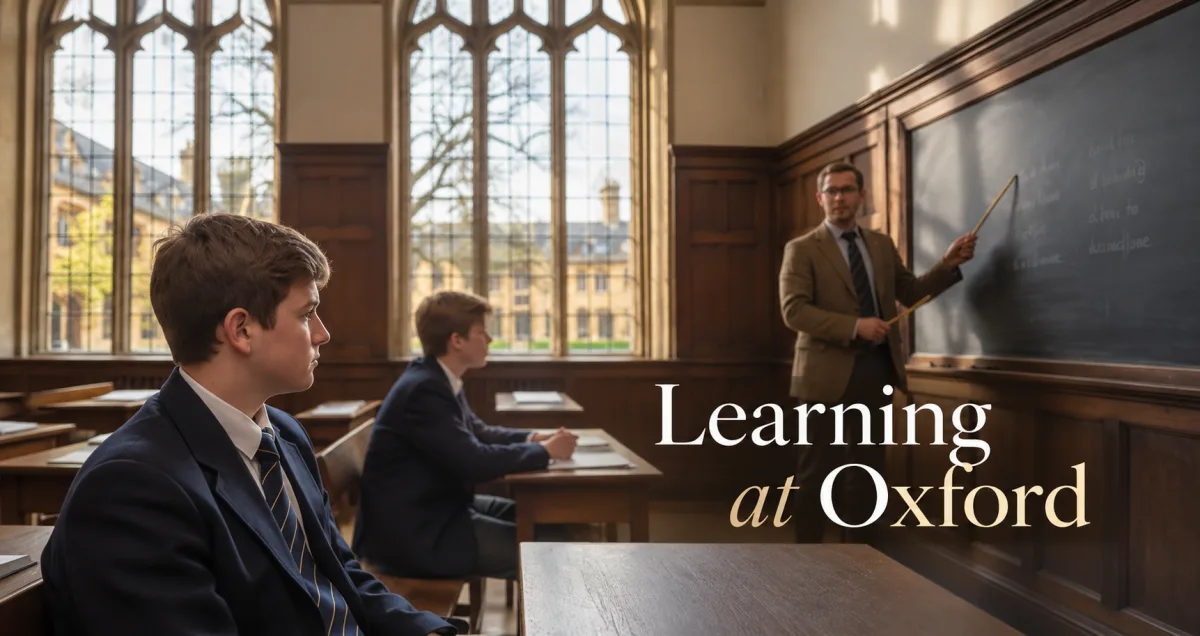
One of the central elements of academic life is the tutorial – a teaching format built around direct discussion between a tutor and a small group of students. Typically, such sessions involve one tutor and two or three students, creating an environment for in-depth, personalised academic discussion.
At the heart of this approach is not the passive acquisition of ready-made answers, but the exchange of ideas. Students are expected to be prepared to present their own views and justify them, listen carefully to others, accept constructive criticism, and respond to questions. Oxford explicitly emphasises that tutorials are based on an exchange of ideas: students learn not only to answer questions, but also to ask them and to evaluate thinking in terms of its clarity, accuracy, depth, breadth, and relevance. For this reason, discussion is not an addition to learning here, but one of its fundamental tools. This format also changes the way students approach mistakes. In a discussion, it is not enough simply to repeat the correct answer; it is important to explain how you arrived at it. One’s own argument may be challenged, while a familiar point of view may be reconsidered in response to a new question or a different perspective. It is through this process that thinking becomes more profound: students do not simply acquire information, but test their own understanding, learn to defend a position or, when necessary, revise it.
The purpose of such discussion is to explore a complex question together. The University’s official materials describe tutorials as regular and intensive academic discussions that enable students to explore ideas in detail and receive continuous individual feedback. In such an environment, the tutor does not merely transmit knowledge but also asks questions that help students identify weaknesses in their arguments, establish new connections, and formulate their ideas more precisely.
Modern education requires not only people who can find information, but also those who are capable of interpreting it, examining it, questioning it, and forming their own well-reasoned conclusions. Discussion teaches students to think independently, speak with confidence, and remain open to other ideas. And perhaps this is one of the most important academic skills of all: not simply knowing the answer, but understanding why you believe it to be correct and being prepared to think again.