The year 1478 is often considered the founding date, as that was when the first book (Expositio in symbolum apostolorum) was printed in Oxford. However, historians emphasize that this merely indicates the appearance of a printing press in the city, rather than the establishment of a fully-fledged university press.
Why is 1478 not yet a publishing house? Prior to the 17th century, universities in Europe did not own publishing houses in the modern sense. They typically hired third-party craftsmen to print books. Early Oxford printers of the 1470s–1480s operated independently, and official references to the position of "printer to the university" (notably Joseph Barnes) did not appear until the 1580s.
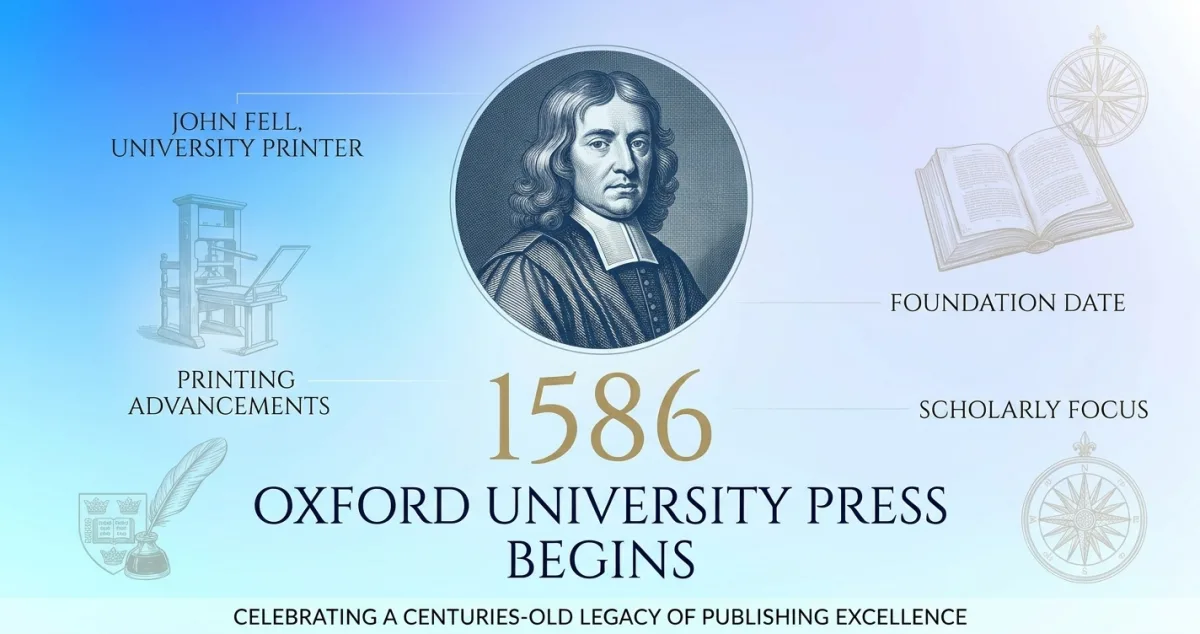
The official founding date of Oxford University Press (OUP) is considered to be 1586, when the University of Oxford obtained a royal decree (a Star Chamber decree) granting the right to print and publish books.
Evolution of the structure: The moment of transition from "university printer" to a fully-formed press can be traced to several periods:
In 1619, when the university first acquired its own printing equipment.
In the 1630s, when a dedicated Delegacy (governing committee) was established and governance standards were laid down under Chancellor William Laud.
In the 1660s, when dedicated premises (the Sheldonian Theatre) were provided.
In the 1780s, when the university finally resumed direct control over the commercial printing of Bibles, bringing all operations under unified administrative control.
Thus, the history of OUP is a long evolutionary journey from the first printed page in the 15th century to today's global academic institution.
Source: Based on materials from the official OUPblog — When did Oxford University Press begin?.