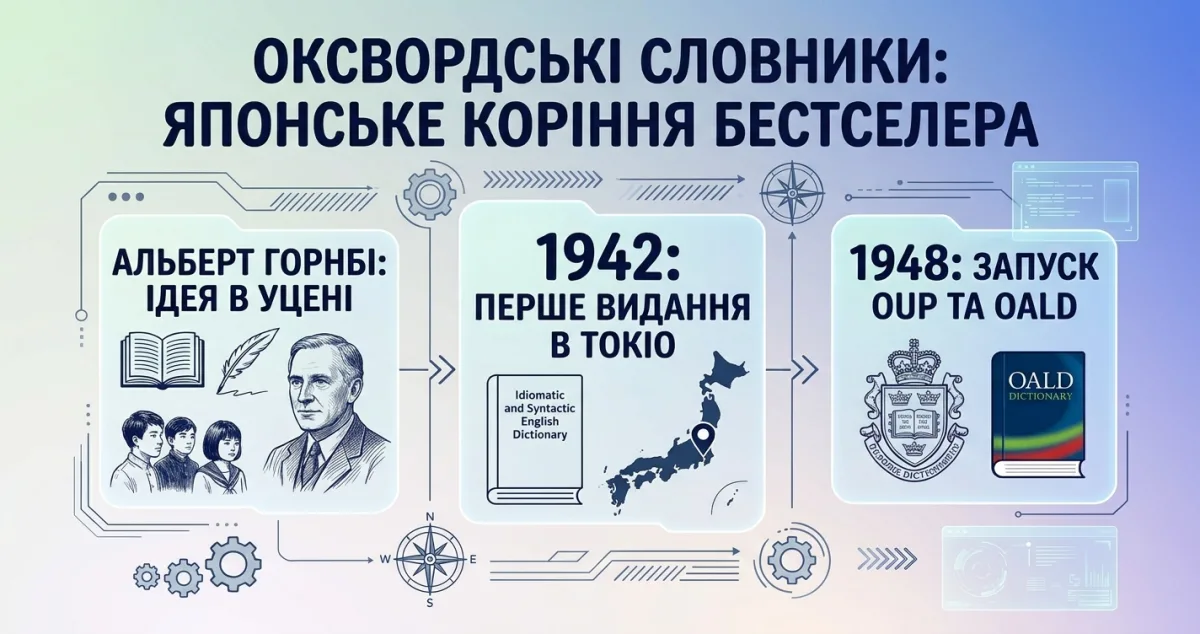
In 1923, educator A. S. Hornby arrived in Japan to teach English language and literature. Working with Japanese students, he noticed an interesting trend: while students could easily answer grammar questions and fluently read complex classical texts, they faced a massive barrier when trying to speak independently or write a simple letter.
Traditional academic dictionaries of that era contained complex, outdated definitions that only confused foreign learners. Hornby realized that a new type of reference book was needed—one that would not just explain the meaning of words, but teach how to use them correctly.
From Notes to the First Tokyo Edition
Hornby began collecting and categorizing simple word explanations, developing verb pattern models, and adding practical sentences from everyday speech.
The result of this multi-year effort was a predecessor dictionary titled Idiomatic and Syntactic English Dictionary. Its first edition was published in Tokyo in 1942 by the Kaitakusha publishing house, with support from a British Council division.
A Perilous Journey to Oxford and Worldwide Success
Due to World War II, returning to Britain was extremely difficult; however, Hornby managed to send the dictionary's proof sheets to London. They reached Humphrey Milford, who was then the head of Oxford University Press. OUP immediately recognized the potential of the idea: the dictionary offered a revolutionary approach to English Language Teaching (ELT) for its time.
In 1948, Oxford University Press republished Hornby’s work under the title The Advanced Learner’s Dictionary of Current English. The dictionary instantly became the gold standard in language learning.
The Legacy of A. S. Hornby
Today, the Oxford Advanced Learner’s Dictionary has gone through 10 editions, with total circulation reaching tens of millions of copies. Albert Hornby channeled the royalties from the dictionary's early editions into establishing the A.S. Hornby Educational Trust, which continues to provide grants and scholarships to English language teachers worldwide.
Джерело інформації: Офіційні архівні матеріали видавництва Oxford University Press (OUP Archive) та біографічний фонд A.S. Hornby Educational Trust.